What is the June birth flower?
The June birth flower is the rose, with the honeysuckle as the second. The Old Farmer's Almanac's reason is simple: both have long been linked with June, when they reach their peak.
What does the rose mean?
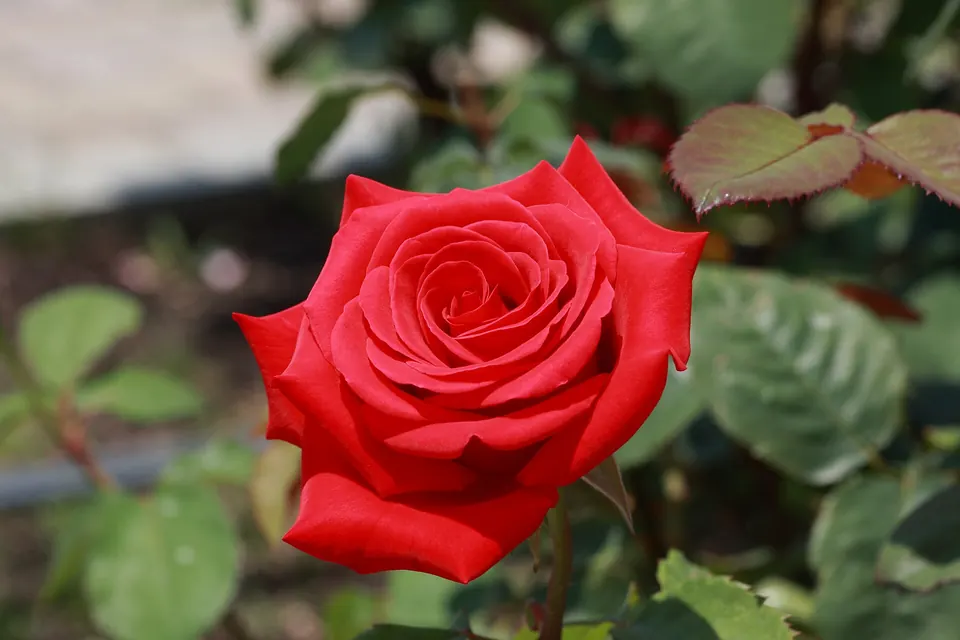

The rose means love. Kate Greenaway's 1884 Language of Flowers gives the plain rose that one word, then spends more than thirty entries on the rest: the rosebud, the single rose, roses by color, roses by variety. No flower in her book has more.
It's also the most official flower in America. In 1986 President Ronald Reagan signed the law making the rose the national floral emblem of the United States, and roses are the state flowers of Georgia, Iowa, New York, North Dakota and Oklahoma.
Older history gave it other jobs. The Romans hung a rose over a meeting to mean that what was said stayed there, which is where sub rosa, “under the rose,” comes from. England's Wars of the Roses were fought between the white rose of York and the red rose of Lancaster, and Greenaway lists a white and red rose together as “unity.”
What does the honeysuckle mean?
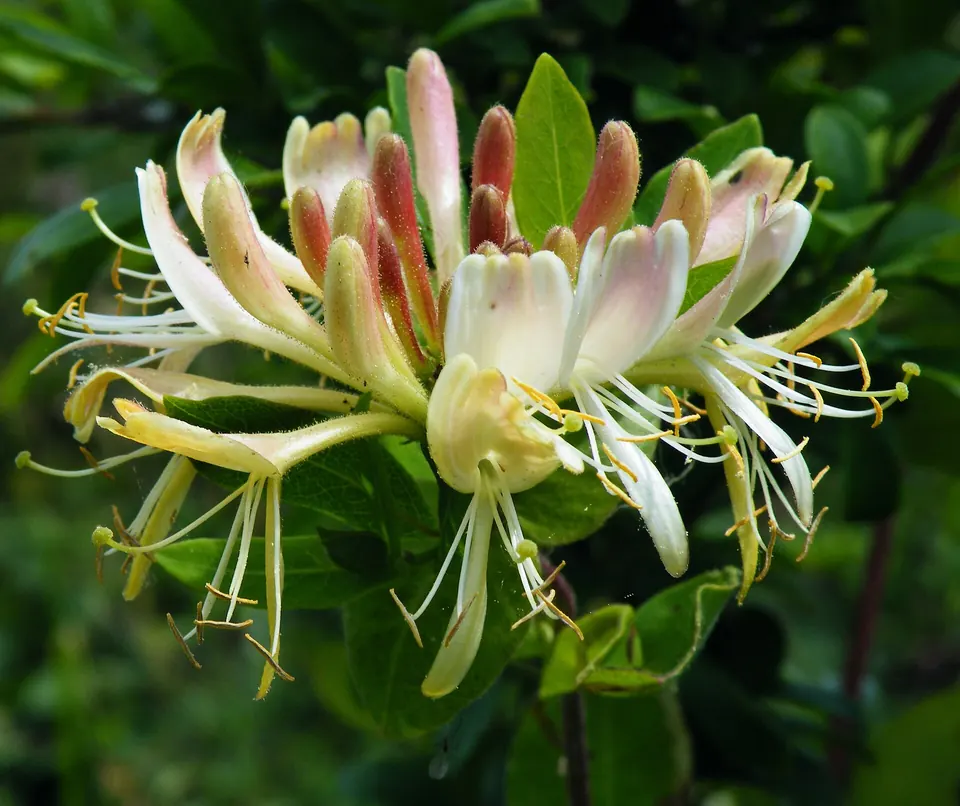

The honeysuckle means generous and devoted affection. The Almanac shortens it to “bonds of love,” and the idea comes from how it grows: a climber that twines around whatever is next to it and holds on.
Shakespeare saw the same thing. In A Midsummer Night's Dream, Titania, wrapped around the man she loves, says “So doth the woodbine the sweet honeysuckle gently entwist.” Woodbine is the European honeysuckle's old name.
Greenaway lists two more: French honeysuckle for “rustic beauty” and coral honeysuckle for “the colour of my fate.” The coral honeysuckle is American, native from Maine to Florida and west to Texas.
What do rose colors mean?
Rose colors are the most looked-up flower meanings there are. Here are the six that come up most, with Greenaway's 1884 reading next to the Almanac's modern one.
| Color | Victorian meaning, 1884 | Modern meaning |
|---|---|---|
| Red | Red rosebud: “pure and lovely” | Love, romance, “I love you” |
| White | “I am worthy of you” | Innocence and purity |
| Yellow | “Decrease of love, jealousy” | Cheer and happiness |
| Pink | Not listed by color | Happiness and admiration |
| Orange | Not listed | Desire and excitement |
| Lavender | Not listed | Love at first sight |
White rose meaning. A white rose means innocence and purity, which is why it's a wedding flower; Greenaway even has a separate entry for the bridal rose, “happy love.” Her white rose is bolder, though: “I am worthy of you.” It was also the badge of the House of York, and paired with a red rose it means unity.
Yellow rose meaning. Here the old and new lists part ways. To the Victorians a yellow rose meant fading love and jealousy. The Almanac now gives it cheer and happiness and notes the jealousy only as old folklore, so today it's a flower for friends. In the US it has a song of its own, “The Yellow Rose of Texas,” a folk song first published in the 1850s.
Why does June have two birth flowers?
The Almanac pairs a primary and secondary flower for most months, since traditions vary and not every flower grows everywhere. June's two make a nice contrast: the rose is the most bred and pampered flower in the garden, and the honeysuckle is the one scrambling over the hedge at the bottom of it. Both are at their best in the same few weeks.
June birth flower tattoo ideas
The rose is probably the most tattooed flower there is, so the honeysuckle is a good way to make a June piece your own.
- A traditional rose. The bold, old-school American rose with thick outlines and solid red never goes out of style, on a forearm, hand or calf.
- A honeysuckle vine. The twining stems and long, curved flowers can wrap around an arm or ankle, a nod to the “bonds of love” meaning.
- Rose and honeysuckle entwined. Titania's line made visual: a rose stem with honeysuckle winding up it, for a couple or a parent and child.
- Pick your color. Since every rose color has a meaning, the color is part of the message: red for love, yellow for a friend, white for a new start.
When and where do they bloom?
Wild roses are native across the Northern Hemisphere, North America included, and the garden roses most of us know are cultivated hybrids. The honeysuckle of the old books is European; America's own is the coral honeysuckle.
Rose
Rosa, the genus · Rosaceae
- Native to
- Wild roses grow across the Northern Hemisphere: Europe, Asia, North America and North Africa, reaching south to Ethiopia. Garden roses are cultivated hybrids.
- In flower
- Late spring into summer. The Virginia rose, a wild rose of the eastern US, flowers June to early August.
Honeysuckle (woodbine)
Lonicera periclymenum · Caprifoliaceae
- Native to
- Europe, from Portugal and Ireland to Norway, Poland and Greece, plus Morocco.
- In flower
- June to August, in Flora Helvetica's records for Switzerland.
Coral honeysuckle
Lonicera sempervirens · Caprifoliaceae
- Native to
- The eastern and central US, from Maine to Florida and west to Iowa, Kansas and Texas.
Native ranges come from the World Checklist of Vascular Plants as published by World Flora Online (CC BY 4.0), names and families from Wikidata (CC0), and flowering times from the floras listed under Sources. They describe the wild plant; garden and florist flowers follow their own calendars.
Catch it in PocketPetal
In PocketPetal, a rose is a catch like any other plant: snap it, image recognition names it, the game rolls a rarity from Common to Mythic, and it joins your collection. June is the month to do it, with public rose gardens at their peak and roses in front yards on every block. Admire them from the path.
Honeysuckle is a good find on hedges, fences and trail edges. Catch the same rosebush on two different days and each catch rolls its own rarity, so the second visit might beat the first.
In the Northern Hemisphere, June catches count toward Summer Sun, the badge for catching a plant in summer. See how rarity works, the badges, and our walk ideas for a summer route.
Sources and photo credits
- Birth flowers: The Old Farmer's Almanac, “Birth Month Flowers and Their Meanings”, the US list most American sources follow.
- Victorian meanings: Kate Greenaway, Language of Flowers (London, 1884), public domain, via Project Gutenberg.
- Modern meanings: The Old Farmer's Almanac, June birth flowers and “Flower Meanings: The Language of Flowers”.
- Names and families: Wikidata (CC0): Rosa, Lonicera periclymenum, Lonicera sempervirens.
- Native ranges: World Checklist of Vascular Plants, published by World Flora Online (CC BY 4.0): Rosa, Lonicera periclymenum, Lonicera sempervirens.
- Flowering times: Flora of North America (Rosa virginiana); Flora Helvetica, via World Flora Online (Lonicera periclymenum).
- Photo, rose: Laitche, CC BY 3.0, via Wikimedia Commons.
- Photo, honeysuckle: Phil Sellens from East Sussex, CC BY 2.0, via Wikimedia Commons.